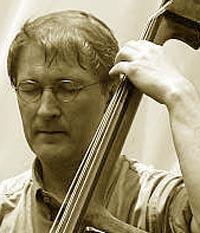
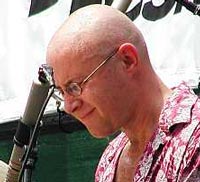
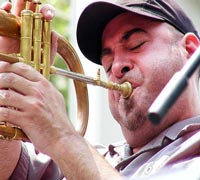
| Playing both bugle and trumpet, Stéphane
Belmondo has emerged as quite a unique musician, and has subsequently become one
of the most sought-after instrumentalists of his generation. He's a poet of the
syncopated passage, a colossus of phrasing, and an explosive or laconic virtuoso
with a rare and skilful use of silence. There is no question that he is one of
the most exceptionally gifted contemporary jazz musicians in France today. There
was always music in the Belmondo home. Back in the small village of Soulies-Toucas,
at the foot of the Var hills, Yvan, the father of these two champions of French
jazz, a former professional saxophonist and the head of a local music school,
instilled his future enfants terribles with a sense of achievement and self-discipline,
and gave them a taste for all forms of music. Having started out on the accordion,
Stéphane chose to take up the trumpet before his sixth birthday. He studied
the cornet at the Aix-en-Provence Conservatory of Music before being admitted
to the trumpet class of the Marseille Conservatory. By 1986, Stéphane Belmondo
had already been awarded his first prize for trumpet in Marseille, and it was
time for him to set out into the real world of live jazz. He had to go "up"
to Paris. Stéphane's path crossed that of pianist René Urtreger,
and he also worked with Alby Cullaz and Michel Graillier. Shortly after his arrival
in the capital, he joined Laurent Cugny's big band "Lumiere." Cugny
had convinced arranger Gil Evans to come to France and work on the orchestra's
repertoire. The collaboration resulted in the release of two albums and a highly
emotional European tour. One night, in 1987, Stéphane was performing at
the Palace - a club which has since disappeared - when Chet Baker heard him and
invited the young musician to join him for a concert the following evening at
the New Morning. On stage, Chet introduced Stéphane to the audience as
the most promising trumpet player of his generation in Europe. The two of them
would have many long conversations and jammed together alone at night; as a result
Stéphane was convinced that jazz was his future. In 2002, in celebration
of the fifteenth anniversary of Baker's death, Stéphane performed a number
of themes associated with the memory of the trumpeter; he was joined by Jean-Louis
Rassinfosse and Philippe Catherine, two of Chet Baker's former partners. Over
a period of three years, from 1987 to 1990, Stéphane played in groups which
were the lifeblood of the Paris jazz clubs, such as pianist Kirk Lightsey's quartet
and bassist Pierre Boussaguet's quintet together with his brother Lionel. Working
with Boussaguet led to the release of an album which gave Stéphane the
chance to record alongside one of his idols, American trumpeter Tom Harrell. Stephane
briefly worked with Pierrejean Gaucher's group Abus and after that went on to
become one of Michel Legrand's favourite soloists. The composer hired him for
his big band and brought him in regularly for studio sessions, thus he had the
chance to perform all over the world, travelling as far as Japan. At the same
time, Stéphane had become one of the mainstays of the big band which his
brother had formed with saxophonist François Théberge, and was also
playing in Jean-Michel Pilc's "Big One", a formation of thirteen musicians
which made quite an impact in spite of its short-lived existence. After forming
a quintet with his brother, Lionel, and their project with Dee Dee Bridgewater's
trio, in 1995, Stéphane decided to go and live in the Mecca of Jazz, New
York City. Toshiko Akiyoshi, Al Foster, Mark Turner and David Kikoski are just
some of the many established or soon-to-be famous names that he played with during
this time. His quartet was signed by the legendary Blue Note label. He also rejoined
Dee Dee Bridgewater for an American tour, performing at the Newport Festival and
appearing at New York's legendary Carnegie Hall. From 1997 to 1999, Stéphane's
career was split between the States and Europe. In New York, he recorded with
pianist Donald Brown, while back in Paris he joined his brother, contributing
to electronic music pioneer DJ Frédéric Galliano's experimental
forays. The third Belmondo Quintet album "Infinity" (Shai), released
in 1999, proved that this project was still alive and kicking. Stéphane
returned to Paris to stay where he has played with groups led by drummer André
Ceccarelli, bassist Jean-Marc Jafet, as well as pianist Andy Emler. He has also
partnered pianists Franck Amsallem and Antonio Farao, and he formed a brilliant
duo with guitarist Sylvain Luc. Their album "Ameskeri" was universally
acclaimed. Prestigious instrument maker Henri Selmer invited him to participate
in the development of a series of new bugle and trumpet models which have since
been marketed under the name "Concept". He was also a member of staff
at the IACP, a school for professional musicians formerly directed by his brother.
Having been one of the main soloists in the group which François Théberge
put together around Lee Konitz in celebration of his music, Stéphane joined
the Canadian saxophonist's new ensemble performing the repertoire which can be
heard on the "Elénar" album (Effendi). In 2003, he played magnificently
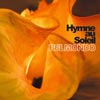
on "Hymne au Solei", a programme of music by composers such as Lili
Boulanger and Maurice Duruflé arranged by Lionel Belmondo for an ensemble
of eleven musicians, where jazz musicians rubbed shoulders with instrumentalists
from major classical orchestras. Today, he finds himself at the helm of a project
based on the songs of Stevie Wonder. "The Jazz Soul of Little Stevie"
was the title of Wonder's second album for Motown and it pretty much sums up the
philosophy behind this project. Lionel naturally stepped in to help out with the
preparation of this project. | |
| We refer to them as "the Belmondos"
in plural because we cannot imagine one without the other. For them, music is
a matter of roots and family, and although their paths diverge occasionally, they
never fail to meet up again.
Strongly influenced by his father, a former saxophonist
and educator, Lionel showed his love for jazz at an early age. And so in 1979,
during his military service in the Air Force, he formed a big band; in 1982, aged
19, he became head of the Central Var School of Music; in 1985, with help from
his father, he formed a regional big band for the Var department; and in 1986,
he organized the first Hyeres jazz festival on the French Riviera. When
Stéphane moved to Paris, Lionel's trips to the the capital became more
and more frequent. He appeared regularly at a number of clubs joining his brother
in Pierre Boussaguet's group, a quintet which also featured a young Jacky Terrasson.
In 1990, following in his younger brother's footsteps, Lionel decided to relocate
to Paris where he performed and recorded for a film soundtrack with Michel Legrand
and his big band. The following year he played with Breton trumpeter Eric Le Lann
in his quintet. The band toured successfully abroad, particularly in Africa. Then
on a whim, in 1992, Lionel formed the Belmondo Big Band together with saxophonist
François Théberge. He also played in Jean-Michel Pilc's "Big
One" and drummer Simon Goubert's quintet, the line-up of which also included
his brother, Stéphane. In 1993, the brothers got together to form their
own quintet and Lionel decided to devote himself to this project exclusively.
The Belmondo Quintet recorded its debut album that same year and the disc features
Lionel on soprano saxophone, an instrument which he had then recently taken up.
He appeared at the Ramatuelle festival that summer sharing the stage with three
masters of tenor saxophone: Johnny Griffin, Guy Laffite and Lew Tabackin. The
following year, Lionel and Stéphane both joined Dee Dee Bridgewater's group.
The singer was working on a tribute album in honour of one of the founding fathers
of hard bop, legendary pianist Horace Silver, and so the brothers had the opportunity
to work alongside one of their idols in the studio. The pianist was agreeably
surprised by his encounter with the brothers and made a point of expressing his
compliments. In the meantime, the Belmondo Quintet had recorded a second album,
"For All Friends", which was released by the Dutch Challenge label.
At the end of 1994, the National Jazz Academy awarded the brothers with the Django
Reinhardt prize for French Musician of the Year. It was a justly deserved reward.After
twelve months of touring internationally with Dee Dee Bridgewater, which gave
him the chance to play the Newport Festival and New York's Carnegie Hall, Lionel
Belmondo decided to get back into teaching and accepted a lecturing post at the
Nadia and Lili Boulanger Conservatory in Paris. In 1996, in collaboration with
his friend François Théberge, he wrote the arrangements for the
brass and strings for a tribute to the music of Bill Evans. In 1997, Lionel became
head of education at the IACP, a school of music for upcoming professional musicians
whose chosen specialty is jazz. He revised the school's teaching methods and restructured
its staff. His experience and meticulous musical knowledge, coupled with his untiring
involvement and input has worked wonders within the school, which, in just a few
years, has contributed to providing a generation of novice jazzmen with the solid
grounding they need on their way to becoming professional musicians. Many have
openly expressed their thanks and recognition, in particular the members of Vintage
Orchestra. In addition to his teaching activities, Lionel Belmondo formed the
group Sax Generations, an ensemble of twelve saxophones which is quite unlike
anything else in the history of jazz; he has played with trumpeter Jean-Loup Longnon's
septet, and also been involved in the direction of arranger Christophe Dal Sasso's
big band, with whom he appeared at the Marciac Festival. The 2001 release of a
magnificent fourth album (recorded live in Bordeaux) by the Belmondo Quintet was
proof that this project was still very much of the now. More surprisingly, the
Belmondo brothers could be found working alongside French electronic music pioneer
DJ Frédéric Galliano. Finally, as a well-respected figure within
the music community, Lionel Belmondo was approached by instrument maker Henri
Selmer to contribute to the development of a new range of saxophones (launched
in March 2000 under the name 'Reference'). At the close of the school season in
2003, Lionel Belmondo decided to give up teaching in order to devote himself to
several new ventures. While the quintet continues to occupy an important place
in his career, his primary focus is currently on writing and arranging. As executive
producer of "Hymne au Soleil", Lionel Belmondo passionately continued
his exploration of French music at the turn of the 19th and 20th centuries. This
relentless activist of a jazz which has finally come of age is now actively engaged
in the development of B-Flat recordings, the label he set up with his brother.
Lionel Belmondo has an insatiable appetite for music and he involves himself with
great enthusiasm and determination in many ambitious projects. Whether he is busy
with the Belmondo Quintet, encouraging ex pupils, or setting up the next sumptuous
new release on his label, he gives the impression of being a man who is more than
happy dedicating himself to serving his muse: music. | |