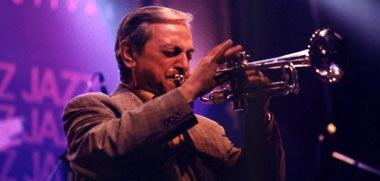
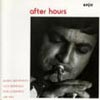
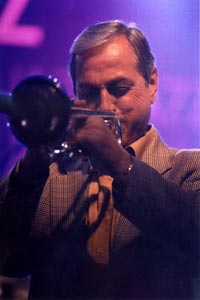
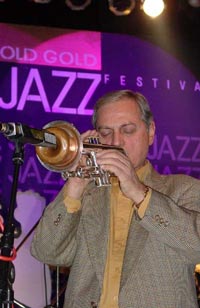
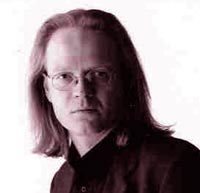
| Born in 1931 in Jajce (Bosnia), Dusko
Goykovich [trumpet, flugelhorn, composer] studied at the Music Academy in Belgrade
from 1948 to 1953. As a youth he played with several jazz and Dixie bands, mostly
for dancing audiences and from time to time at parties at the embassies of the
capital. When the 18-year-old Dusko joined the Radio Big Band of Belgrade, he
was considered a talented young jazz musician who can also read music. When he
left the band five years later, he had grown into a fine big band player and featured
soloist. Dusko went to Germany where he quickly became an integral part of its
uprising young jazz scene. In 1956 he made his first record as a member of the
Frankfurt All-Stars. After a short stint in the big band of Munich's Max Greger,
Dusko stayed for four and a half years with Kurt Edelhagen's band, then Europe's
leading jazz orchestra. Francy Boland, Claus Ogermann, Jerry van Rooyen and Rob
Pronk were among the arrangers who worked for Edelhagen. In addition to being
the band's premier trumpet soloist, Dusko performed with such greats like Stan
Getz and Chet Baker. It came as no surprise when in 1958 he was invited to play
with the Newport International Youth Band at the Newport Jazz Festival. Other
members of the Newport band included Albert Mangelsdorff, Ronnie Ross, George
Gruntz and Gábor Szábo. Following the performance at Newport, Dusko's
trumpet became very popular in Europe. In 1961 the Berklee School of Music offered
the 29-year-old a grant for studying composition and arrangement in Boston where
Herb Pomeroy was to become one of his teachers. Looking forward to writing his
own arrangements for his great love, the big band, Dusko concentrated on his studies
at Berklee so exclusively that he turned down offers by Count Basie, Stan Kenton
and Benny Goodman to join their bands, with regret though. While at Berklee, Dusko
(now also on the flugelhorn) recorded with the Berklee School Quintet and Orchestra
including fellow students such as Gary Burton, Mike Gibbs, Sadao Watanabe, Steve
Marcus, Mike Nock, and Dave Young. When he had just finished his studies and prepared
for his return to Germany, Dusko received a call from a Canadian bandleader Maynard
Ferguson offering him Rolf Ericson's place (who had just left to join Ellington).
Of course, Dusko accepted. Ferguson, a virtuoso trumpeter himself, featured him
as a second trumpet soloist and even used some of his big band arrangements. When
Ferguson's band split in 1964, Dusko joined Woody Herman and stayed with him for
a year. It was his work for Herman that founded Dusko's international reputation
as an outstanding big band player and soloist. "Woody Herman encouraged me
a lot," Dusko recalls. "He not only accepted my big band charts (with
a single exception), but also recorded all of them." The same year Dusko
(together with Sal Nistico) left Herman's band and returned to Europe, eager to
record his own music. Mal Waldron and Nathan Davis played on his sextet album
"Swinging Macedonia" (1966) that emphasized Dusko's personal, Balkan-influenced
style. In those years, Dusko - by then a member of the leading league of international
jazz artists - also worked with Miles Davis, Dizzy Gillespie, Gerry Mulligan,
Clark Terry, Lee Konitz, Sonny Rollins, Phil Woods, Duke Jordan, Thad Jones, Mel
Lewis, Slide Hampton and many more. From 1966 he continued his big band career
as a member of the Clarke-Boland Big Band that assembled some of the best musicians
living in Europe, among them US ex-patriates Benny Bailey, Idrees Sulieman, Johnny
Griffin, Sahib Shihab, Jimmy Woode and - of course - Kenny Clarke. The CBBB was
probably the finest jazz orchestra of the sixties, but it seldom played for live
audiences. After his time at Berklee, Dusko Goykovich began writing big band charts
of all for his compositions and many standard tunes. He has been asked to play
his arrangements with many European big bands, among them the Dutch Skymasters
and NDR big band. In Munich (where he settled down in 1968) Dusko soon started
his own "rehearsal" big band including musicians such as Rolf Ericson,
Palle Mikkelborg, Rudi Fuesers, Ack van Rooyen, Ferdinand Povel, and Frank St.
Peter. Due to the difficulties in organizing a European free-lance orchestra,
this band broke up in 1976 and was revived only for some performances in 1981/82.
Yet in 1986 Dusko was able to re-found his own orchestra which has been on the
scene ever since. In 1993, he also started a much-acclaimed international comeback
as a recording artist with his prize-winning CD "Soul Connection" featuring
Tommy Flanagan, Jimmy Heath, Eddie Gomez and Mickey Roker. Soul Connection was
followed by "Bebop City" which featured young alto sax wizard Abraham
Burton, Kenny Barron on piano, Ray Drummond on bass and Alvin Queen on drums.
1996 saw the fulfillment of a long standing wish for Dusko: the recording of his
own big band playing his music, "Balkan Connection". 1997 saw the release
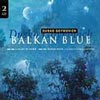
of the 2-CD set "Balkan Blue", another high point in his career. Disc
One features a wonderfully relaxed quintet with Italian master saxophonist Gianni
Basso and Disc Two is an extended work performed by the NDR Philharmonic with
a jazz rhythm section and Dusko Goykovich as soloist. His compositions were arranged
by Palle Mikkleborg (who did a similar piece of work for Miles Davis). Balkan
Blue evokes strong memories of Miles Davis' work with Gil Evans - a seminal recording
of our days. | |
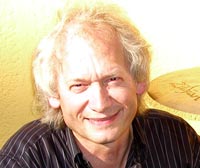
| Bernhard Pichl was born 1966 in Hilpoltstein,
near Nuremberg, Bavaria, in Germany. He started playing the piano at the age of
12 and had his first concerts wihen he was 16. He studied Jazz and Classical Piano
at the Conservatory of Wuerzburg (1989 - 1995) with Chris Beier, and also with
Don Friedman, Andy LaVerne, Rob Bargad and Kenny Werner in New York. From
1988 to 1991 he was a member of the "Landesjugend-Jazzorchester Bayern"
(leader Dusko Goykovich), with which he had several tours, radio broadcasts and
CD productions. In 1992 he went for a four week gig at "Half Note Jazz Club"
in Athens as a member of the Rick Hollander - Tim Armacost Quartet, and in 1994/1995
he went on tour with the NYC Saxophone player Pete Yellin ("Pete Yellin´s
European Connection"). In 1994 he made his first appearance as a guest soloist
with the Philharmonic Orchestra Wuerzburg (Jazz meets Classic). Since 1994 he
has been a member of the "Sunday Night Orchestra", and through membership
worked with Maria Schneider, Jerry Bergonzi, Tim Hagans, Ingrid Jensen and Bart
von Lier. A CD production and touring with trumpeter Benny Bailey marked 1995
and 1996. After that he became a member of the international Jazz Sextet "Ugetsu",
staying there for 4 years. During that time they had many tours throughout Europe
(Greece, Belgium, Denmark, France, Italy…) China (1998) and South Africa
(1999). Since 2000 he has been a member of Valerie Ponomarev´s "Universal
Language" featuring Jimmy Cobb, with which he tours in Holland, Austria,
Germany, Denmark, Italy, etc, as well as the "Dusko Goykovich international
Jazz Quintet" appearing at the Jazz and Blues Festival in Tel Aviv in 2002.
He has worked with jazz legend James Moody, Charlie Mariano and the Philharmonic
Orchestra Wuerzburg (CD), ex-Kenton trumpet player Conte Candol, the Nuremberg
Symphonic Orchestra - conducted by Maria Schneider, and as a sideman with Bobby
Watson's Band "Horizon's", featuring Victor Lewis. Besides that, Pichl
has worked with such greats as: Toots Thielemanns, Rolf Kühn, Teddy Edwards,
Bob Mintzer, Charlie Antolini, Ack van Rooyen, Jimmy Woode, Attila Zoller, Gianni
Basso, Joe Nay, Jack Walrath, Curtis Lundy, Bobby Shew, Victor Lewis, Jimmy Cobb,
Rachel Gould, Deborah Brown, Greetje Kauffield, Tim Hagans, Jimmy Rotondi, Annette
Lowman, Al Porcino and Alvin Queen and appeared at the following: the Leverkusen
Jazz festival, the Jazz festival Leipzig, the International Jazz Week Burghausen,
the Jazz East-West Nuremberg, the Jazz festival Beijing, the Jazz festival Shanghai,
the Jazz festival Bolzano... Bernhard Pichl is currently teaching at the Hochschule
Nuremberg and Hochschule Wuerzburg. | |
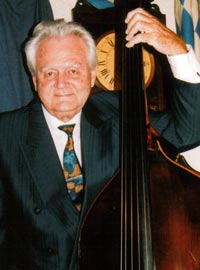
| He was born on 26th August 1927 in Stari
Becej. He started studying the violin when he was 6 and - as an autodidact - the
accordion and the piano. A bit later he took up the piano, too. Even then he was
irresistibly drawn to the music of modern American composers from the radio and
records. When he was in his second year of high school (1939) he became a permanent
member of the School Little Dance Band organized by a few older students. Beside
international dance music and so called novelty-compositions, the band played
songs from American musicals, such as compositions by Irving Berlin, George Gershwin,
Duke Ellington, etc. In 1946, as a student of Mechanical Engineering in Belgrade,
he was immediately accepted as an accordion and piano player among his peer musicians
who played all over town at dances, which were very popular at the time. In 1949
he started playing the double bass, as well. In 1949 he became a conductor-leader
and arranger (as well as a piano player from time to time) of the jazz band 'Polet',
which played live on Radio Belgrade 2 on a regular basis for jazz programs. After
Radio Belgrade 2 was terminated he became the arranger for the Light Music Orchestra
of the radio station Belgrade 1 as well as Spasa Milutinovic's sextet where he
played the double bass. In 1955 at an invitation of jazz musicians from Frankfurt,
he left for Germany, where he appeared at the 3rd German Jazz Festival as the
bass player for the Juta Hip-Atila Coler Quintet, and after that works with many
other jazz bands in West Germany. From 1956 to 1961 he was a bassist, arranger
and singer in the sextet of the jazz violin player Helmut Veglinski. From 1961
to 1972 he played the bass in Max Greger's television orchestra. In 1964 he unexpectedly
made a guest appearance with the Duke Ellington Band when his bass player had
a heart attack, so Pejakovic replaced him with no prior rehearsal. He appeared
with the jazz ensemble of the Bavarian radio (leader: Don Menza) and from 1972
he worked as a free-lance studio bassist, made a number of records, film and television
music (with even very prominent conductors such as Henry Mancini, for example).
In 1983 he became active on the Munich jazz scene. He is an assistant professor
and arranger for the Bavarian Youth Jazz Orchestra and an arranger and bass player
for the Dusko Goykovich Munich Big Band, whom he has worked with for many years.
(He has been an official court interpreter (he passed the state examination) as
well as literary translator since 1974). | |